

Welcome to Grey Face Rescue!
Thank you for opening your heart and home to a Grey Face Rescue foster dog. By becoming a foster, you're giving a senior dog the opportunity to decompress, heal, and prepare for the next chapter of their life—a forever home.
Bringing a new dog into your home is exciting, but it's also a big transition for everyone involved. Many of our foster dogs are adjusting to unfamiliar surroundings, recovering from medical procedures, learning new routines, or simply experiencing a safe and loving home for the first time in a long while. Patience, consistency, and understanding go a long way in helping them feel secure.
Before bringing your foster dog home, please make sure everyone in your household understands and supports the commitment. Creating a calm, structured environment from day one will help your foster dog settle in more comfortably and set them up for success.
Thank you for being an important part of our mission to honor senior dogs by giving them the love, care, and second chance they deserve.
If you need any support or have questions or concerns while fostering with Grey Face Rescue, please fill out our Foster Request Form.
Getting Started
Before your foster dog arrives, make sure everyone in your household understands and supports the fostering commitment. Preparing your home ahead of time will help create a smooth, low-stress transition.
Foster Care Guidelines
Keep your foster dog in a main living area where your family spends time—they should feel included, not isolated.
Use a crate or baby gate to safely confine your foster when you're away or unable to supervise.
Decide ahead of time who will be responsible for feeding, potty breaks, and daily care.
Grey Face Will Provide
Crate/Kennel
Dog Bed & Blankets
Food & Bowls
Toys
Treats & Chews
Diapers or Puppy Pads (if needed)
Collar & Leash
Medications (if applicable)

Who to Contact
Grey Face Rescue is a 100% volunteer-based organization. Our team balances rescue responsibilities with full-time jobs, families, and personal commitments. We appreciate your patience as we work together to support you and your foster dog.
Email is our primary form of communication. If you haven't received a response within a reasonable timeframe, please send a friendly follow-up before reaching out to another team member.
Intake Team
Coordinates your foster dog's arrival into rescue and transportation to our St. Joseph office.
Email: ownersurrender@greyfacerescue.org
Foster Manager
Your primary point of contact throughout your fostering experience. Contact them with questions, concerns, or submit a Foster Request Form for assistance.
Email: foster@greyfacerescue.org
Veterinary Team
Coordinates veterinary appointments and provides guidance regarding your foster dog's medical care.
Email: vetting@greyfacerescue.org
Adoption Team
Manages adoption applications, interviews, reference checks, home visits, and placement updates.
Email: adoption@greyfacerescue.org
Supplies
Need food, medications, or other supplies? Submit a Foster Request Form, and we'll coordinate pickup or delivery when possible.
Medical Emergency (After Hours Only):
(320) 223-3393
For true emergencies only. All non-emergency requests should be submitted through the Foster Request Form or emailed to the appropriate team.
The First Day
The first day can feel either very easy or very stressful—and both are completely normal. Your foster dog has just experienced a major life change and needs time to decompress, adjust, and learn to trust their new environment.
What You May See
Accidents or marking
Not eating or drinking much
Whining or pacing
Tension with resident pets (especially if introduced too quickly)
Growling or snapping due to fear or stress
These behaviors are common during the adjustment period and do not necessarily reflect your foster dog's true personality.
Setting Your Foster Up for Success
Keep pets separated for at least the first 24 hours before making introductions.
Give a guided tour of the home and yard on leash, avoiding nose-to-nose interactions with other pets.
Create a safe space using a kennel or gated area in a room where your family spends time.
Keep a leash attached indoors during the first week to safely redirect your foster if needed.
Establish a potty routine by using the same door and taking them outside frequently.
Let your foster approach you. Give them space and avoid hugs, face-to-face contact, or overwhelming attention, especially from children.
End the day with a walk. A little exercise before bedtime can help reduce stress and encourage a good night's sleep.
Remember: Your foster dog isn't trying to be difficult—they're simply adjusting. Patience, routine, and consistency during the first few days will help them feel safe and begin to settle into their new home.
The First Two Weeks
The first two weeks are all about helping your foster dog decompress and settle into a routine. Every dog adjusts at a different pace, so patience and consistency are essential.
Focus on Routine
Establish a consistent schedule for feeding, potty breaks, walks, and rest.
Balance family time with short periods alone to build confidence.
Reward calm behavior rather than responding to whining or attention-seeking.
Keep Things Simple
Limit visitors and other overstimulating situations during the first few days.
Give your foster time to learn your home, routine, and family before introducing new experiences.
Be Patient
Your foster dog's past experiences may influence how they react to everyday situations. They may be fearful of leashes, hesitant around hands, unsure of household routines, or unfamiliar with basic commands. Allow them time to build trust and confidence.
Veterinary Care
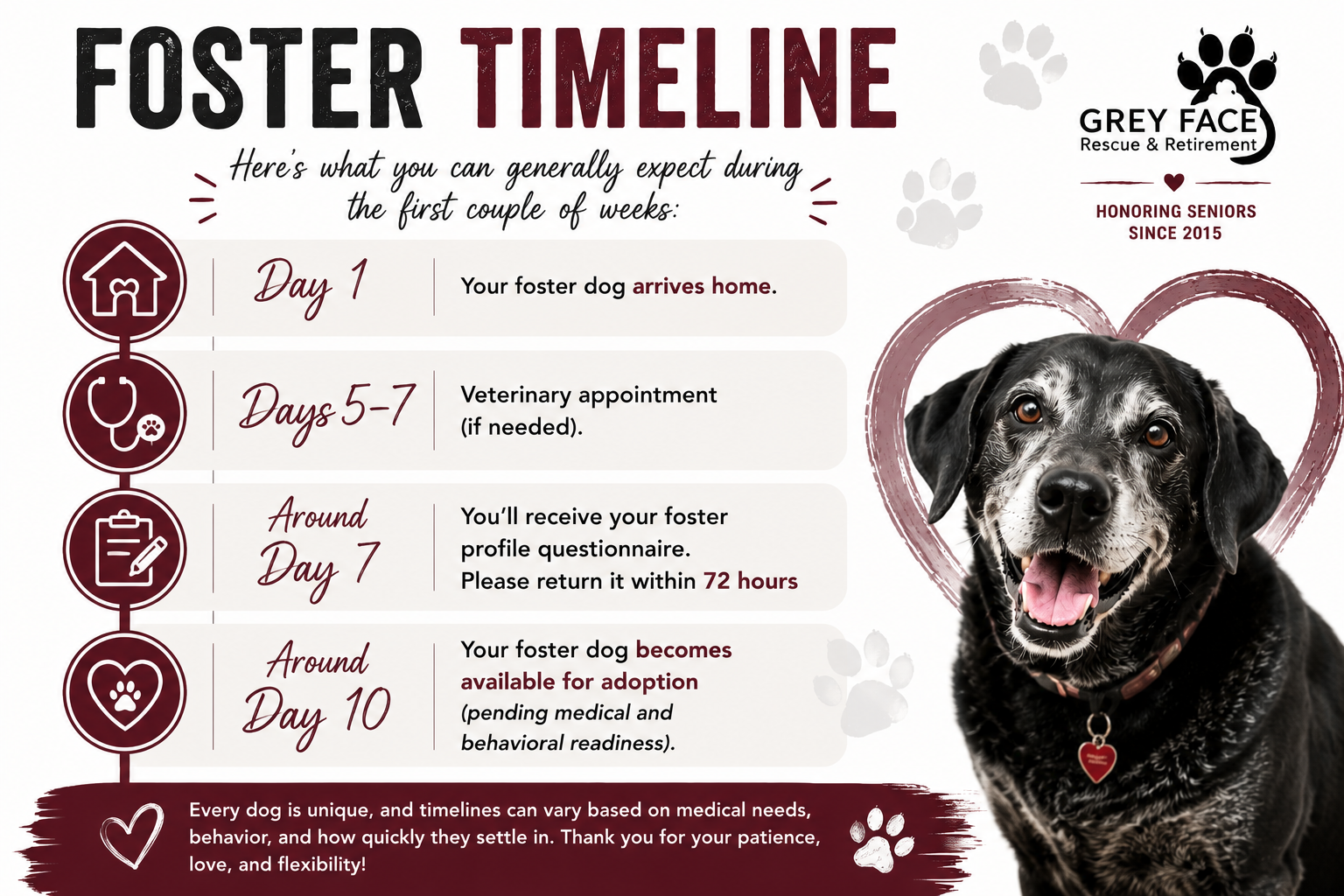
Our team will contact you within 5–7 days to schedule a veterinary appointment (if needed). This allows your foster dog time to decompress while we coordinate medical records and care plans.
Need Help?
If you have questions or need assistance, please submit a Foster Request Form. We're here to support both you and your foster every step of the way.
WHAT TO FEED YOUR FOSTER
Grey Face provides food for your foster dog, primarily through community donations. Because of this, food types and brands may vary. We prioritize senior dog food and specialty diets when recommended by a veterinarian. If a prescription diet is required for medical reasons, the rescue will cover the cost.
Please contact the foster team or visit the office if you’re running low on food. Let us know when you have about a two-week supply remaining.
Encouraging Your Foster to Eat
Feed on a consistent schedule (typically twice daily)
Leave food down for 15 minutes, then remove it to build routine
Limit or pause treats until regular eating improves
Try a different bowl, location, or feeding height
Mix in wet food or a different kibble
Add warm water to dry food to enhance smell
Offer a bland diet short-term (plain chicken, rice, pasta, potatoes, or lean ground meat—no seasoning)
Diet Changes
A change in diet may cause temporary diarrhea. If this occurs, feed plain cooked rice with lean ground turkey or hamburger (drained), then gradually reintroduce kibble.
Food Allergies
Watch for signs like hot spots, skin irritation, or sores on paws. Start with simple, easy-to-digest foods (chicken-based kibble). If sensitivities appear, try alternatives like duck or fish. Contact the Vetting Team if symptoms persist.
Foods to Avoid
Alcohol, avocado, caffeine, chocolate, coffee, citrus, coconut, grapes, raisins, nuts, ham or ham bones, dairy, onions, garlic, chives, xylitol (found in some peanut butter), yeast, and cinnamon.
BACK TO THE TOP
INTRODUCING RESIDENT ANIMALS
Proper introductions are critical—they set the tone for your foster dog’s entire stay. Taking it slow helps build safe, positive relationships from the start.
Resident Dogs
First 24 hours: Keep dogs separated. Allow them to smell each other by rotating spaces (one out, one in).
After 24 hours: Take both dogs on a long walk together to burn energy and build familiarity.
Initial meeting: Introduce indoors with leashes on and a baby gate between them. Keep this setup for at least 24 hours.
Watch behavior: If either dog shows signs of stress (growling, baring teeth), extend separation time.
Supervised interaction: When ready, allow short, leashed interactions without a barrier. Separate regularly to prevent overstimulation.
Ongoing: Gradually increase time together as they adjust.
Important: Never leave your resident dog and foster dog unattended.
Resident Cats
First 24 hours: Keep separated while allowing scent swapping.
Initial meeting: Use a leash on your foster dog and a baby gate as a barrier. Maintain separation for at least 24 hours.
Watch behavior: If your foster shows intense interest, growling, or tension, continue separation longer.
Supervised interaction: Keep your foster dog leashed during introductions without a barrier. Keep interactions brief and controlled.
VACATIONS / TEMP FOSTERS
Going out of town? We’ve got you covered—just plan ahead!
What to Do
Post in the Army Facebook Group with a photo of your foster, dates needed, and key details (dog/cat/kid friendly, stairs, etc.).
If you don’t find a temp foster, submit a Foster Request Form. Our team will reach out to other fosters or arrange boarding if needed.
Plan Ahead
Please request a temp foster at least 2–3 weeks in advance. Short notice requests may be difficult to accommodate.
Important
Foster dogs may only stay with approved fosters. Leaving your foster with an unapproved family member, friend, or neighbor is not allowed and may result in removal from the program.
Supplies & Office Hours
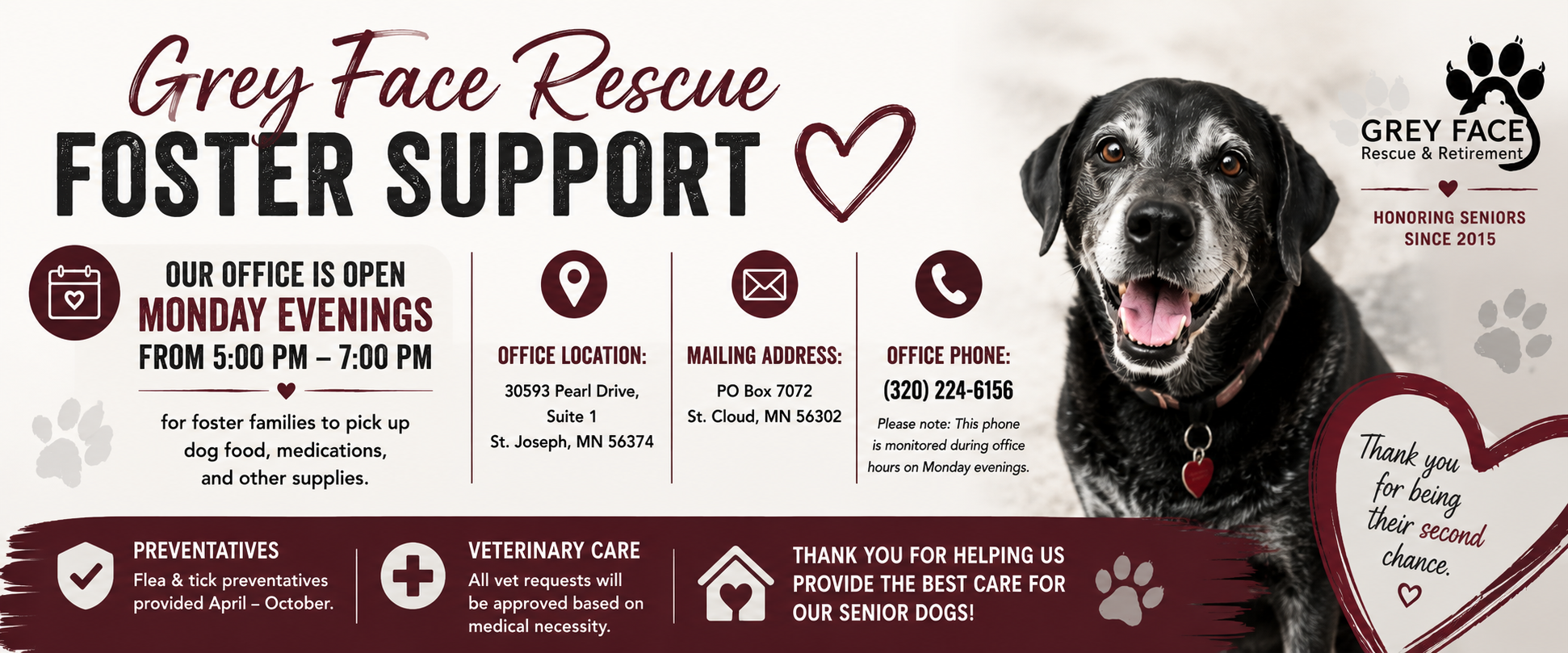
Our office is open every Monday from 5:00 PM – 7:00 PM for foster families to pick up supplies, medications, food, and other rescue items, as well as drop off donations or learn more about Grey Face Rescue.
Office Location
30593 Pearl Drive, Suite 1
St. Joseph, MN 56374
Available Supplies
We keep a variety of foster supplies in stock, including:
Crates & Kennels
Dog Food
Treats & Chews
Toys
Beds & Blankets
Collars, Leashes & Harnesses
Medications (as prescribed)
Other foster supplies as available
Please note that our office is 100% volunteer-run, so office hours may occasionally change. Supply availability also varies based on donations, and we cannot guarantee that specific items will always be in stock.
If you need additional supplies or are unable to visit during office hours, please submit a Foster Request Form or contact your Foster Manager so we can coordinate assistance.
PROMOTING YOUR FOSTER DOG
While many people visit our website and social media, your efforts can make a big difference in helping your foster find a forever home. The more you share, the better their chances!
Ways to Promote Your Foster
Take photos and videos and post them in the Army Facebook Group so we can share them.
Share your foster on your personal social media accounts.
Always walk your foster dog wearing an “Adopt Me” bandana.
Attend Grey Face adoption events—fosters are expected to attend at least one per month. (Please bring only your foster dog.)
Talk to potential adopters honestly, using positive, thoughtful language. For example, “working on house manners” instead of “not potty trained.”
Email friends, family, and coworkers and ask them to help spread the word.
Post flyers at work, school, or community spaces you’re part of.
Ask if you can bring your foster dog to work or feature them in company newsletters or internal sites.
Share your foster’s story on blogs or community pages.
Visit high-traffic areas (parks, lakes, downtown) and bring a friend to help talk with interested people.
Consider dog-friendly events like local 5Ks (check rules first).
Tips for Taking Great Photos
We can’t stress this enough ... a picture is worth a thousand words.


TAKING GREAT PHOTOS OF YOUR FOSTER
Photos are often the first thing potential adopters see—and a great picture can make all the difference. Clear, high-quality images help your foster stand out and generate more interest.
Photo Tips
Take lots of photos. It may take 50 shots to get a few great ones.
Use natural light. Shoot outdoors when possible, with the light behind you to avoid shadows.
Capture attention. Use treats or a squeaky toy to get the dog’s best expression (having a helper can make this easier).
Try portrait mode if your phone has it.
Choose a simple background. Pick a backdrop that contrasts with the dog’s coloring—grass works great for most dogs.
Use props. Bandanas, toys, or colorful collars can add personality and visual interest.
What to Capture
Close-up “hero” shots focused on the face
Full-body shots to show size
The dog interacting positively with people or other animals (if appropriate)
Set Your Dog Up for Success
Exercise your dog before the shoot to help them relax
Aim for a calm, happy expression (a slightly panting dog often looks like they’re smiling!)
Keep the dog as the main focus—avoid busy backgrounds
Final Tips
Look at adoptable dog photos online (like Petfinder) for inspiration
Don’t get discouraged—practice helps, and it should be fun for both you and your foster!
Reach out to our team if you need help
PREPARING YOUR FOSTER FOR ADOPTION
Great news—your foster is about to be adopted! As a foster, it’s your responsibility to help ensure a smooth transition to their new home.
Before Adoption
Contact your Foster Manager to request any needed medication refills
Prepare enough food to be transitioned
Items That Go With Your Foster
Blankets (no large beds)
Medications (if applicable)
Food (at least a 1-week supply)
Items to Return to the Rescue
Kennel/crate
Large beds
Collar, leash, harness
Food bowls
Enrichment toys
Litter boxes
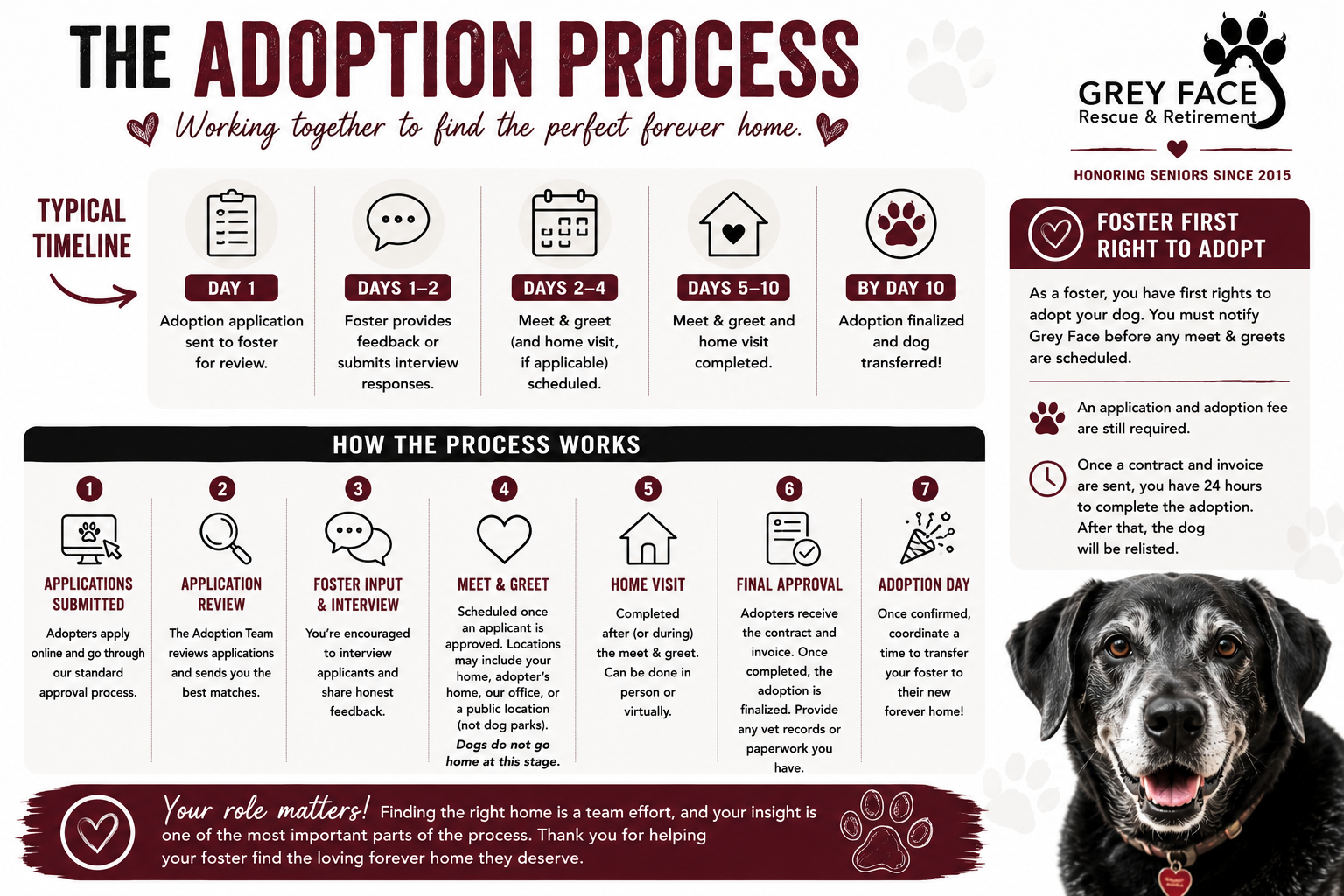
The Adoption Process
Our goal is to place every foster dog in the best possible home as quickly as possible, allowing us to continue rescuing more senior dogs in need. Throughout the adoption process, your feedback is invaluable—you know your foster dog better than anyone.
Typical Timeline
Day 1
Adoption application(s) shared with the foster for review.
Days 1–2
Foster provides feedback and/or interviews prospective adopters.
Days 2–4
Meet & greet and home visit scheduled (if applicable).
Days 5–10
Meet & greet and home visit completed.
By Day 10
Adoption finalized and your foster heads to their forever home.
Foster First Right to Adopt
As the foster, you have the first opportunity to adopt your foster dog. If you're interested, please notify Grey Face Rescue before any meet & greets are scheduled.
An adoption application and adoption fee are still required.
Once an adoption contract and invoice have been sent, they must be completed within 24 hours, or the dog will become available for other approved adopters.
How the Process Works
Applications Received
Prospective adopters submit an online application and complete Grey Face Rescue's approval process.Application Review
The Adoption Team reviews applications and sends you the best match(es).Foster Feedback
You're encouraged to review applicants, ask questions, and share your honest feedback with the Adoption Team. If you'd prefer, a volunteer can assist with interviews.Meet & Greet
Once an applicant is approved, a meet & greet is scheduled. This may take place:Your home
The adopter's home
Grey Face office (if available)
A pet-friendly public location (excluding dog parks)
Please note: Dogs do not go home following the meet & greet.
Home Visit
A home visit is completed in person or virtually to ensure the home is a good fit.Final Approval
The adopter receives the adoption contract and invoice. Once completed, the adoption is finalized. Please provide any veterinary records or paperwork you have at the time of adoption.Adoption Day
Coordinate a transfer time with the adopter and celebrate your foster's next chapter!
Your Role Matters
Finding the right home is a team effort, and your insight is one of the most important parts of the process. The meet & greet should be a conversation that helps determine whether the dog and adopter are the right fit for one another.
Some helpful questions include:
How will your dog get daily exercise?
How would you handle behavioral challenges or training needs?
What does a typical day look like in your household?
Thank you for helping your foster find the loving forever home they deserve. Your time, patience, and dedication truly change lives.
Return of a Foster Dog
While we hope every adoption is successful, we understand that sometimes a placement isn't the right fit. If an adopter chooses to return your former foster dog, Grey Face Rescue will work quickly to ensure they receive the care and support they need.
Return Policy
Per the Adoption Contract:
Adopters are asked to allow their new pet at least three days to adjust to their new home before requesting a return.
If a return is necessary, the adopter must contact the Grey Face Adoption Team directly.
Dogs are returned to the Grey Face office in St. Joseph no sooner than 72 hours after notifying the Adoption Team.
If a new foster home has not been secured within that timeframe, the adopter may be asked to continue caring for the dog until an appropriate foster placement becomes available.
If an Adopter Contacts You
If the adopting family reaches out to you directly, please thank them for contacting you and kindly direct them to the Grey Face Adoption Team. This ensures we can follow our return process, support the adopter, and coordinate the best next steps for the dog.
Thank you for helping us ensure every dog continues to receive the care, stability, and support they deserve—even if an adoption doesn't go as planned.
Lost Foster Dog Protocol
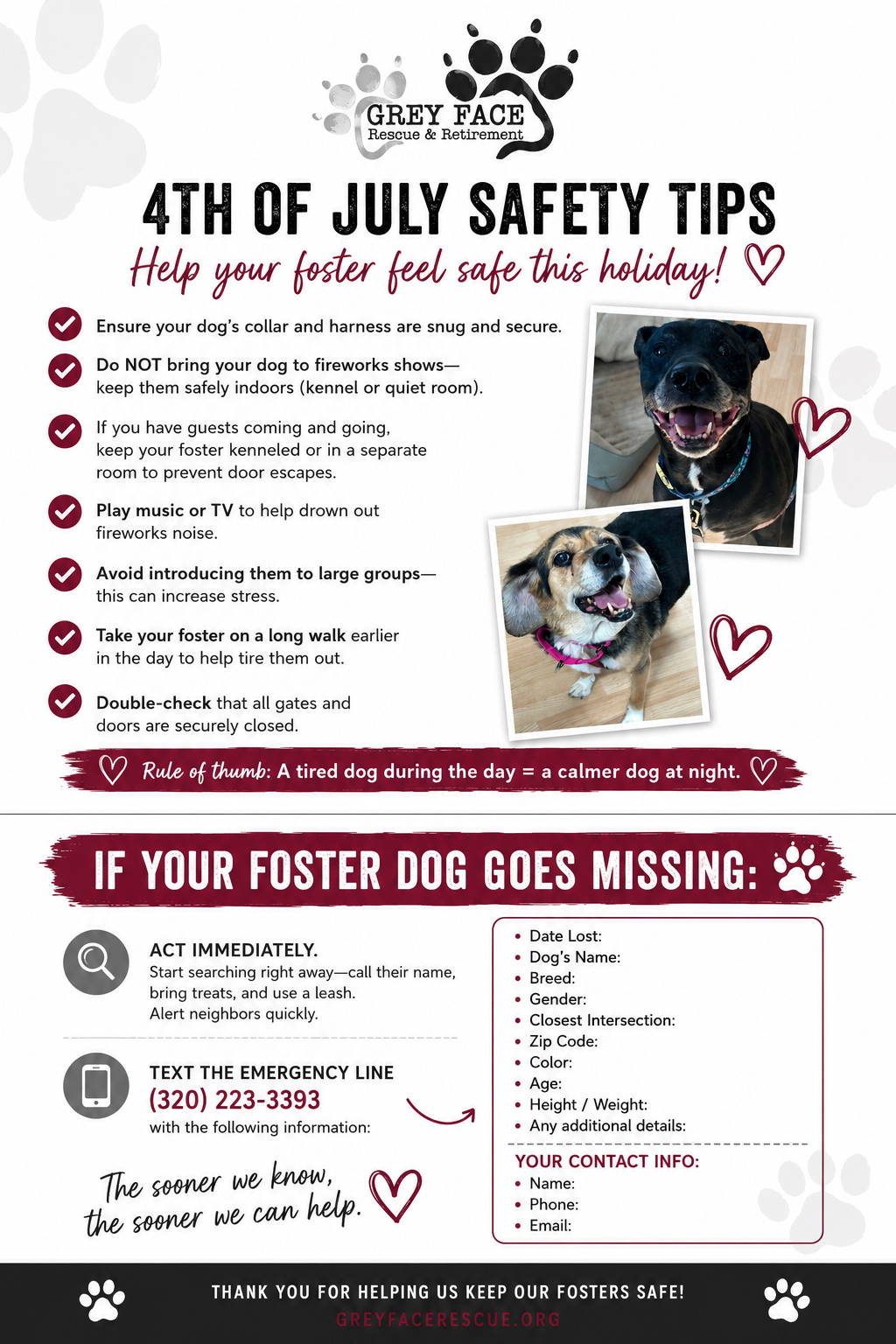
If your foster dog goes missing, act immediately. The first few hours are critical and can greatly increase the chances of a safe return.
Step 1: Contact Grey Face Rescue
Text the emergency line (320) 223-3393 with the following information:
Date Lost:
Dog’s Name:
Breed:
Gender:
Closest Intersection:
Zip Code:
Color:
Age:
Height / Weight:
Any additional details:
Your Contact Info:
Name:
Phone:
Email:
Text is best so we can quickly copy/paste and share to Facebook.
Step 2: Start Searching
Don't wait—begin searching the area right away.
Bring a leash, treats, and your dog's favorite toy.
Call your foster dog's name in a calm, encouraging voice.
Check nearby yards, wooded areas, garages, and hiding places.
Continue searching on foot and by vehicle if possible.
Step 3: Stay Close to Home
Have someone remain at your home or the location where your foster dog went missing in case they return on their own.
Place familiar items outside, such as:
Food and water
Their bed or blanket
A kennel (if available)
Clothing with your scent
Step 4: Let Grey Face Take Over
While you continue searching, our team will immediately begin coordinating additional search efforts by:
Contacting local veterinary clinics
Notifying nearby shelters and animal control
Posting to Lost Dogs MN and other local lost pet resources
Sharing on Grey Face Rescue's social media
Recruiting volunteers to assist with the search
Remember: Stay calm, act quickly, and maintain communication with the Grey Face team. We will work together to bring your foster dog home safely.
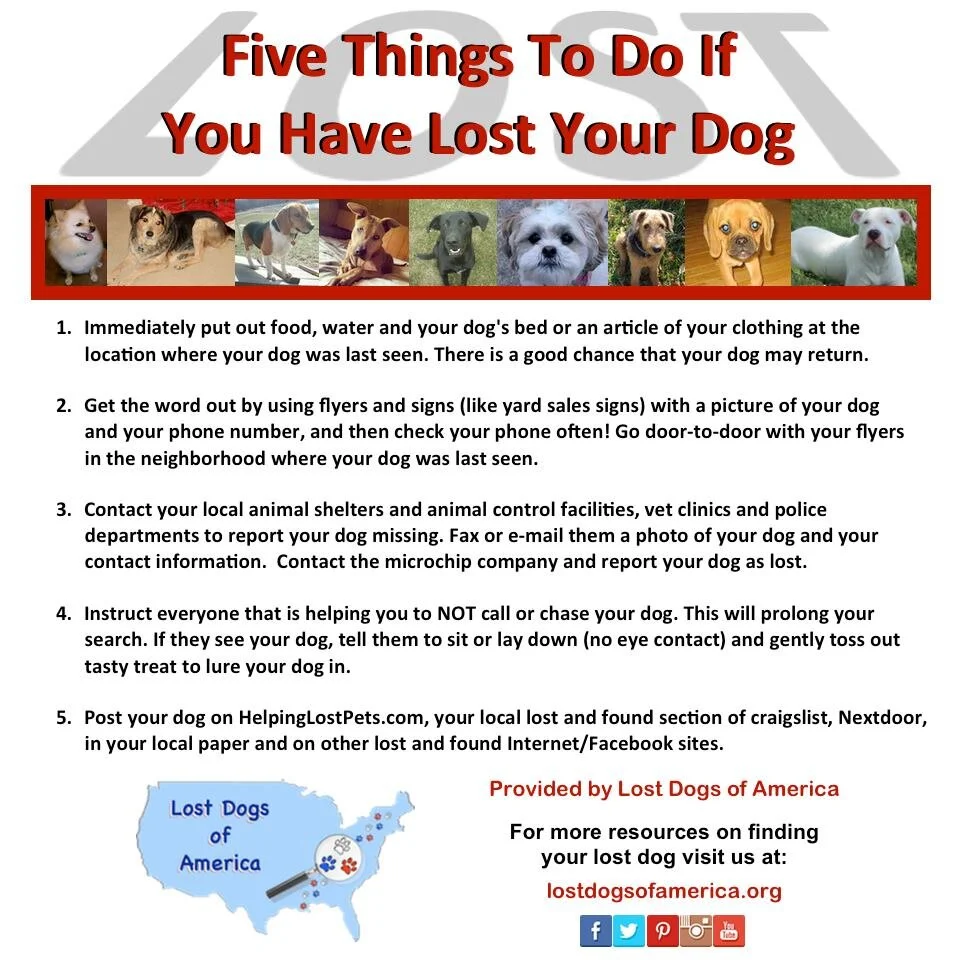
Follow the LOST DOGS ACTION PLAN here.
Removal from our foster program
At times, unfortunately, we have to remove foster families from our program. It’s tough but these decisions are made with the best interest of the animals in mind. We understand wholeheartedly that fostering can be difficult and down right frustrating but that’s why it is so rewarding! We take in animals that would otherwise cross the rainbow bridge and give them a second chance at a forever family. In some cases, that comes with some struggles.
In order to help our families, we have created tools and resources for our fosters to utilize to make the experience of fostering easier. This portal is filled with resources and content, as well as, our Facebook Army Group which is to be used to connect with other foster families when needing advice or encouragement. We also partner with the best veterinary practices that continue to work hard to provide care for our animals.
Reasons for removal:
Not providing proper care to your foster animal.
Not responding to communication efforts made by the Grey Face Team.
Breaking of confidentiality
Failure to adhere to policies or follow procedures
Inactivity
Inappropriate drug or alcohol use
Inappropriate or unprofessional conduct during your time of fostering. We ask that all fosters show professionalism during events, interviews, meet and greets.
Excessive “no-show”or cancelations of veterinary appointments.
Misrepresentation of Grey Face Rescue & Retirement
Theft and/or not returning all supplies that is the property of Grey Face Rescue.
Violence or implication of violence.
Requesting removal of an animal for convenience.
Leaving your foster in the care of an unapproved foster family.
Depending on the situation, you will be either become inactive for 30 days or removed completely from our program.
We truly hope that the relationship with our foster families never has to result in removal but we have to make the best decisions for our animals and their care. We hope when that decision is made the family respects it and we continue to move forward.
By filling out the form below, you have read and understand the training materials provided by Grey Face Rescue and have access to these training materials during your duration as a Grey Face Rescue Approved Dog Foster.